


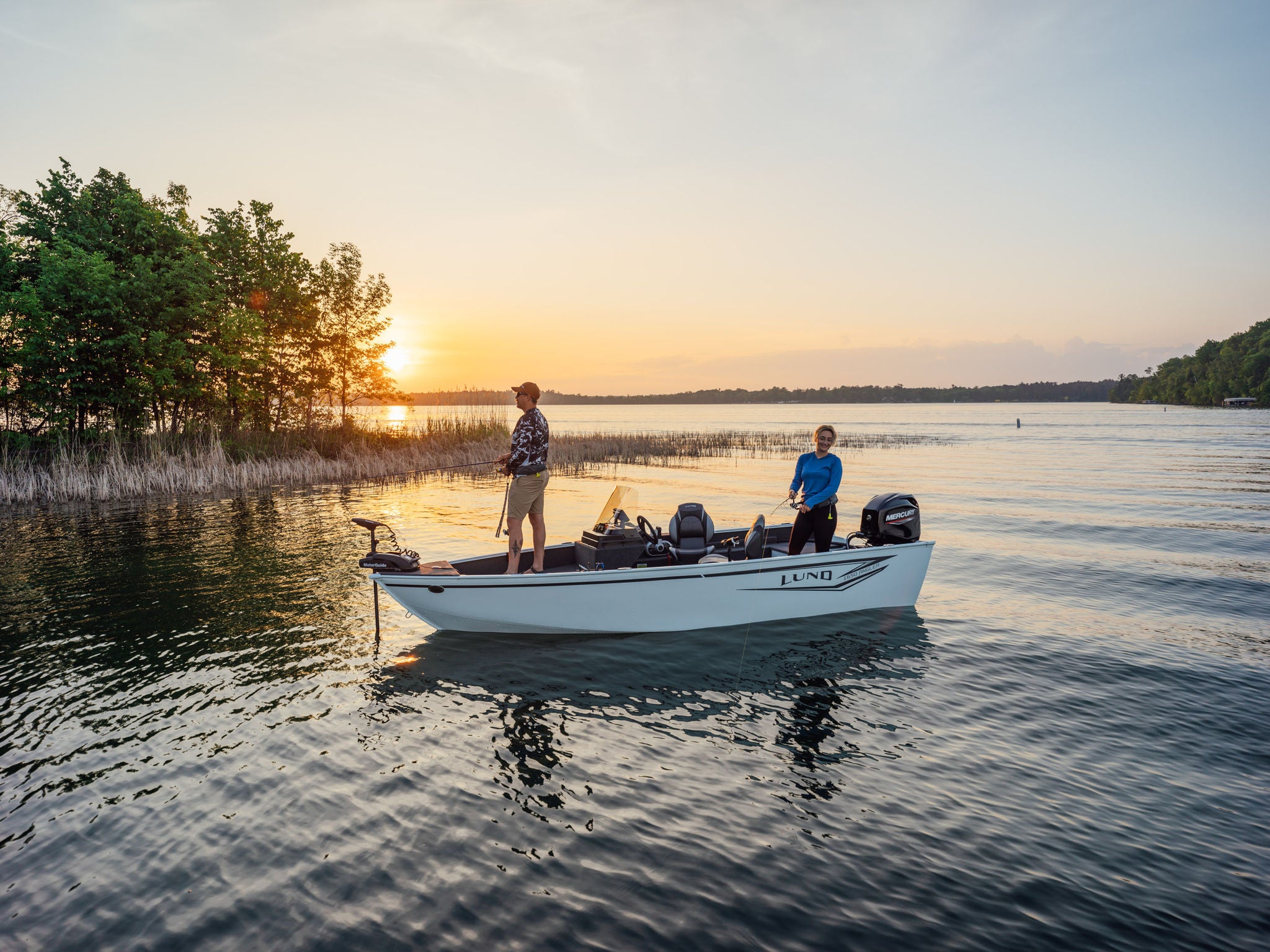
Deep V Boats for Walleye, Trout, Salmon, and Smallmouth Bass
An In-Depth Look from the Industry Leader in Deep-V Boats for Northern, Big Lake Fishing
The information provided is for general informational purposes only. This information is based on the author’s personal experience and does not constitute financial or legal advice. You should consult with a professional and/or conduct your own independent research to verify any information in this post prior to making a financial decision or otherwise.
Many fishing boats are claimed to be handcrafted, but almost none of them match the skill and precise diligence required to build a deep hull fiberglass boat. Among the various manufacturers of fiberglass boats, Lund commands respect that few others can approach
STEP 1: DESIGN
The Lund 202 Pro-V GL—the preferred boat of northern guides and tournament anglers—is built to perform flawlessly in the big water lakes inhabited by trophy walleye, salmon, trout, and smallmouth bass. Lund fiberglass hull design is informed by decades of practical experience in unforgiving waters in all weather and all seasons. The ideal amount of freeboard—the hull’s height from waterline to gunnel—abates wind resistance and minimizes undesirable drifting. Precisely angled chines reduce spray and improve handling when turning. A set-back transom enhances performance by promoting clean water flow to the prop, minimizing cavitation. Finally, a pad molded into the aft keel allows the boat to ride with less resistance when accelerating and on plane, increasing top speed and engine efficiency..
STEP 2: MOLD AND GEL COAT
As with all fiberglass boats, construction begins with a mold. Formed as a negative of the finished hull shape, its finely polished surface is cleaned thoroughly and then taped to allow multiple gel coat colors and patterns to be applied. The build then begins from the outside in, starting with colored and metal-flaked gel coatings that will form an impenetrable barrier and create Lund’s distinctive style. Multiple layers of gel coat are hand-sprayed onto the mold’s surface in a dust-free room to maintain purity of finish for vivid colors and a lifetime of durability.
STEP 3: LAYING THE FIBERGLASS
Then comes the fiberglass. Skilled fiberglass technicians apply cross-woven fabric by hand, soak it with advanced resin, then roll out any trapped air. They then spray chopped fiberglass in alternating layers with the fabric. Why two types of glass? Woven fabric provides structural strength, and chopped glass adds puncture resistance.
The process repeats multiple times until the desired thickness is reached—and this thickness varies according to the durability needed in any given area. The keel and chine bends will have more glass, and the flat planes in the hull less. Using exactly the right amount of fiberglass and resin where it is needed optimizes the weight of the hull so that it’s heavy enough to perform in rough water but light enough to accelerate and run with a properly matched outboard. Hull thickness is constantly monitored during the build process. When finished, the hull is set aside to cure.
STEP 4: CURING AND QUALITY CHECK
After curing, the hull is carefully removed from the mold, cleaned, buffed, and inspected for flaws. It then moves down the line to be outfitted with the stringer, deck, and finishing components.
Each step in this process is performed by hand, with the careful eye of an experienced worker attending to every step. This attention-to-detail ends with a final product that exceeds angler expectations in durability and performance—and lives up to the legendary name of Lund.
To experience Lund’s legendary performance for yourself, visit a boat dealer near you today!
This website does not provide financial or legal advice. The information available on this website is provided for general informational and educational purposes only and is not a substitute for professional advice. You should consult with the appropriate professionals prior to making any financial decisions. YOUR USE OR RELIANCE ON ANY OF THE INFORMATION PROVIDED HEREIN IS SOLELY AT YOUR OWN RISK. UNDER NO CIRCUMSTANCE SHALL WE HAVE ANY LIABILITY TO YOU FOR ANY LOSS OR DAMAGE OF ANY KIND INCURRED AS A RESULT OF THE USE OR RELIANCE ON ANY INFORMATION PROVIDED.